


Thanks in part to advocacy and testimony by students from the McKinley Park neighborhood's Horizon Science Academy, the Chicago City Council and 12th Ward Alderman George Cardenas have pushed Chicago to be the first major U.S. city to officially support a Carbon Fee and Dividend policy at the federal level. The adoption of Resolution R2017-915 follows months of outreach from Horizon students, backed by other locally active environmental advocacy groups such as the Citizens Climate Lobby, to get Chicago to adopt the non-binding resolution.
On March 11, Horizon students Evelyn Munoz, Isabel Abarca and Luis Ortega were among the testifiers on behalf of the resolution in front of the Committee on Health and Environmental Protection, which Cardenas chairs. On March 13, the measure passed with every city council member present voting in favor of it.


Carbon Fee and Dividend policy calls for additional taxes to be assessed on carbon-producing energy sources at their point of origin, then returned to the citizenry in the form of a monthly payment. As previously reported here in the McKinley Park News, other local groups like the McKinley Park Development Council have also advocated for adoption of the Chicago resolution, and the benefits for the neighborhood could be significant, as argued in an opinion/editorial piece by Dr. Noah Paulson.
Cardenas has also pushed forward environmental concerns at the City Council level by his recent introduction of an ordinance to bring an independent Department of Environment (DOE) back to Chicago. Ordinance 2019-1560 calls for re-establishment of the DOE to ensure consistency in enforcement of environmental laws, regulations and policies.
“Establishing a DOE acknowledges the importance of environmental protection in Chicago," Cardenas said. “This new department will give our environmental team the autonomy it needs."
Mayor Rahm Emanuel eliminated the DOE in the City of Chicago's 2012 budget as a cost-cutting measure. A recent joint investigation between the Better Government Association and the Medill School of Journalism found that after the department was shuttered, the number of city pollution citations, inspections and enforcement actions declined by massive percentages to a trickle of its previous levels.
"The issues of lead in drinking water, and the need to push the city toward clean, renewable energy, call for greater expertise and leadership," Cardenas said.
The language of the proposed ordinance notes that re-establishing the DOE will also require it to receive funding from the 2019 Annual Appropriation Ordinance.
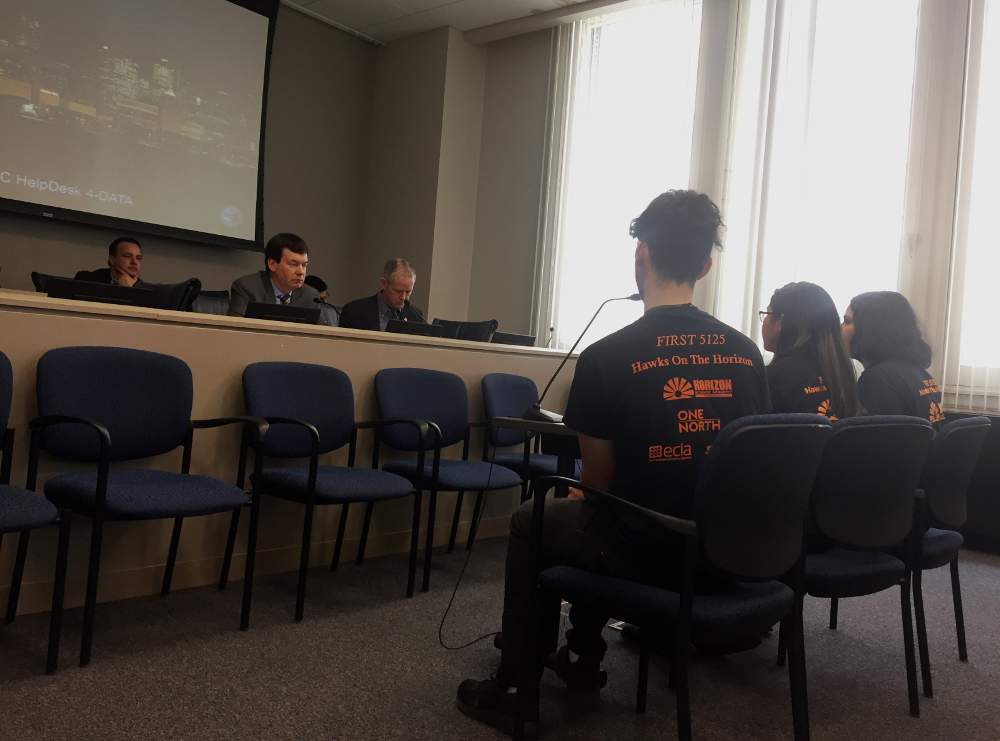 Horizon Science Academy students testify in front of Chicago's Committee on Health and Environmental Protection at its March 11, 2019, hearing on the Carbon Feed and Dividend resolution.


Log In to comment on this item.
Subscribe
Report
My comments