


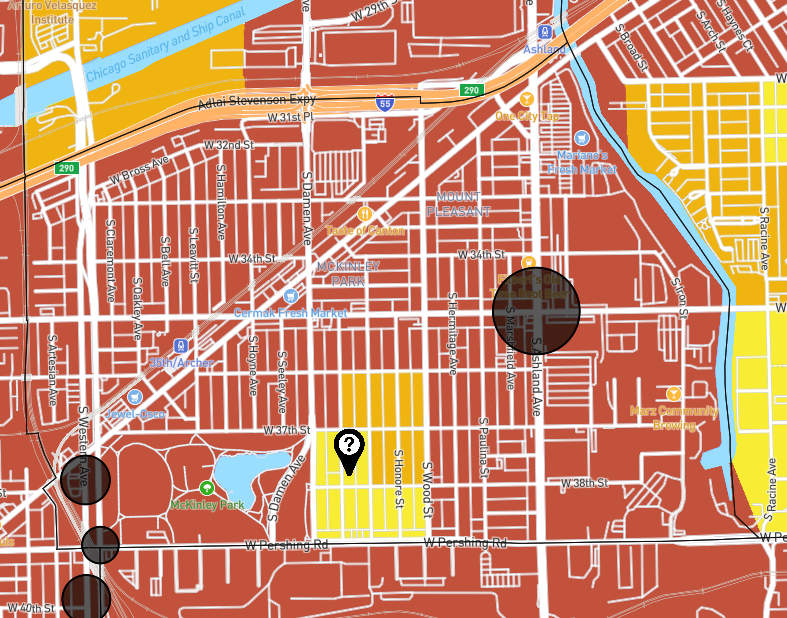
A one-day study of truck counts last summer tallied the number of trucks and buses passing through key intersections on Chicago’s Southwest Side, including three locations in the McKinley Park neighborhood.


In addition to counting the truck and bus traffic at West 35th Street and South Ashland Avenue, at West Pershing Road and South Western Boulevard, and in the 3700 block of South Western Avenue, the study illustrated a cumulative impact showing most of McKinley Park in the highest range of burden for compounded environmental effects, including truck traffic.

This study is the first offering from the Chicago Truck Data Portal, a project of the Little Village Environmental Justice Organization (LVEJO) and the Center for Neighborhood Technology (CNT), employing data gathered by the Fish Transportation Group.
“This project is a step towards fulfilling the need for accessible, community-level truck traffic in Chicagoland,” the Chicago Truck Data Portal states. “Existing truck counts for commercial and industrial vehicles are not easy to attain.”
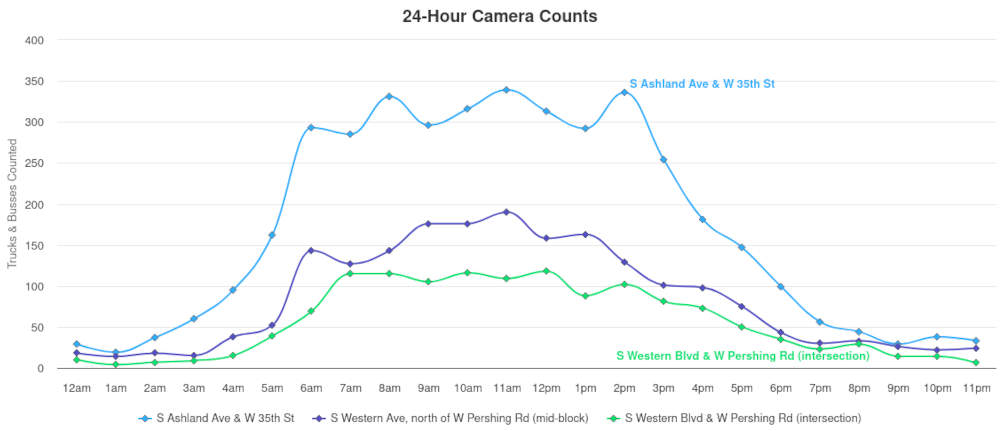 A graph from the Chicago Truck Counts study shows traffic over a 24-hour period at three McKinley Park neighborhood locations.
Over a period of 24 hours on Tuesday, June 6, 2023, a “typical non-holiday weekday,” the study tallied:
- 4,084 trucks and buses passing through West 35th Street and South Ashland Avenue
- 1,346 trucks and buses passing through West Pershing Road and South Western Boulevard
- 2,012 trucks and buses passing the 3700 block of South Western Avenue

No. 2 Truck Hotspot
The location at West 35th Street and South Ashland Avenue had the second-highest count in the study: Only a stretch of South Pulaski Road at West 41st Street in the Archer Heights neighborhood tallied more trucks and buses.
The study, which employed automated Miovision cameras installed by the Fish Transportation Group, included light-goods vehicles such as commercial pickup trucks in its final truck counts.

Cumulative Impacts
The cumulative impacts map considers truck counts, logistics facilities and resident health ailments, the study stated, considering these elements relative to marginalized populations using a CNT-developed process based on the Delivering Zero Emissions Communities program, which funded the study.
The map includes a note that McKinley Park is “one area where freight-focused cumulative impact scores may not align with local lived experiences,” and it stated a May 2024 update is pending.
Legislative Remedies
The Chicago Truck Data Portal advocates for specific legislation to start permanently removing emissions from truck traffic and reducing the burdens borne primarily by low-income and minority areas with designated environmental justice concerns.

The Advanced Clean Trucks (ACT) rule “would require truck manufacturers to sell an increasing percentage of electric trucks year after year,” the portal states. “The Heavy-Duty Omnibus Low-Nitrous Oxide or HDO rule would reduce fossil fuel emissions from new diesel trucks via comprehensive emissions standards.”


Log In to comment on this item.
Subscribe
Report
My comments