


Data centers, including QTS at 2800 S. Ashland Ave. in Chicago’s McKinley Park neighborhood, are under recent scrutiny and face possible regulation from groups and officials concerned about their impact on the environment and local communities.


However, investigation shows that those calling for reigning in data centers still use AI and services from AI companies: the primary source of demand behind the data centers’ explosive growth.

The Let’s Talk Data Centers event convened on August 13, 2026, at Bethany Baptist Church in the McKinley Park neighborhood to present information and call for greater transparency and accountability through the proposed POWER Act, an Illinois law that would mandate transparency and operational changes for data centers.
Rising Electric Costs
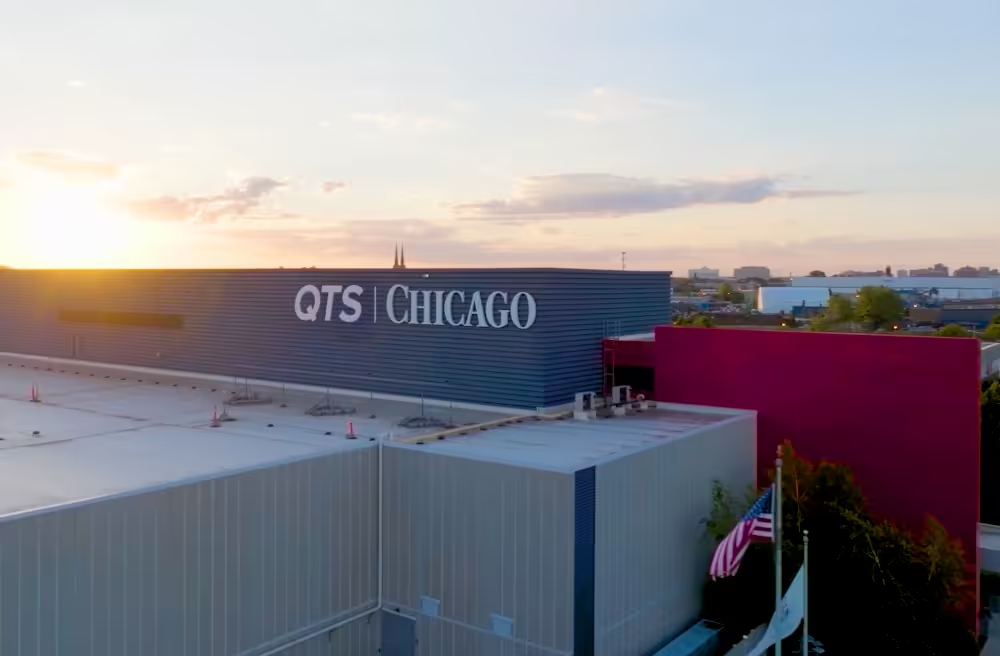 The sun rises over the QTS data center at 2800 S. Ashland Ave, Chicago.“We need guardrails, urgently,” said Lucy Contreras of Green Latinos, which presented the event alongside the Prairie Rivers Network and the Citizens Utility Board. “Development is one-sided.”
Rising electric costs for consumers are a direct result of Illinois data centers, said Andrew Rehn of the Prairie Rivers Network. Large “hyperscale” data centers already approved for Joliet, Yorkville, Greyslake and Springfield would nearly quintuple the state’s energy demand, he said.
Rates 50 Percent Higher
Due to recent capacity auctions in the utility market driven by data center needs, ComEd’s electric rates are 50 percent higher than 2024 rates, said Zoe Huspen of the Citizens Utility Board.

The POWER Act would ensure data centers pay the actual costs of their electricity with no impact on local communities, said Isabella Jaimes of Green Latinos. Right now, loopholes allow data center operators to claim 100 percent clean energy usage, she said.
Unregulated Water Use
“They’re doing a lot of plucking from clean projects,” Jaimes said.
Unregulated water use is another concern around data centers, said the Prairie River Network’s Jizelle Torres. “We don’t know how much water they’re using every day,” she said.
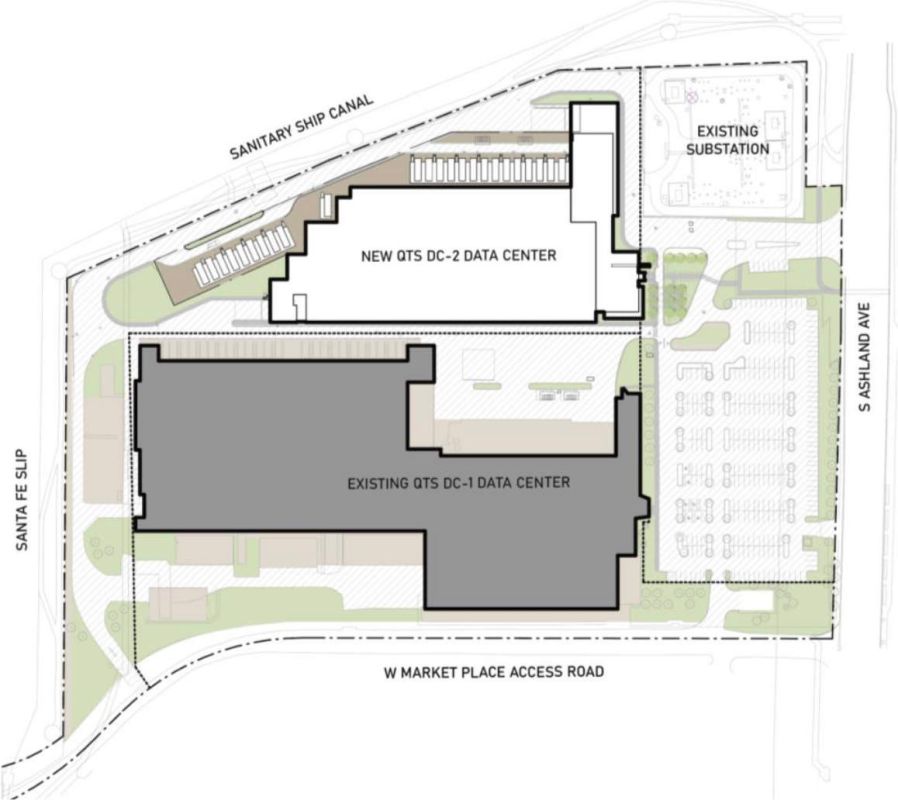 The layout of the QTS Data Center expansion is illustrated in a diagram presented at the development meeting on August 26, 2024.
The POWER Act
Illinois has no modern water laws, Torres said. “We don’t have water-monitoring enforcement in Illinois.”
The POWER Act would mandate data centers’ disclosure of their water use and add water use permit requirements and “genuine cost protections” from increasing local water rates, Rehn said.
NDAs and CBAs
Banning non-disclosure agreements with local governments is another mandate of the POWER Act, Contreras said, to increase public transparency and accountability. A Community Benefits Agreement would also be required for every new data center, she said.


As previously reported here in the McKinley Park News, the neighborhood’s QTS data center received approval in 2024 for nearly doubling the size of its facility on its 30-acre campus, including support from 12th Ward Alderwoman Julia Ramirez.
A Good Neighbor
QTS “has been a good neighbor,” she said in a meeting about the data center expansion.
However, Ramirez recently withheld her approval of a reinstatement of the original QTS building permit, which expired before construction started.
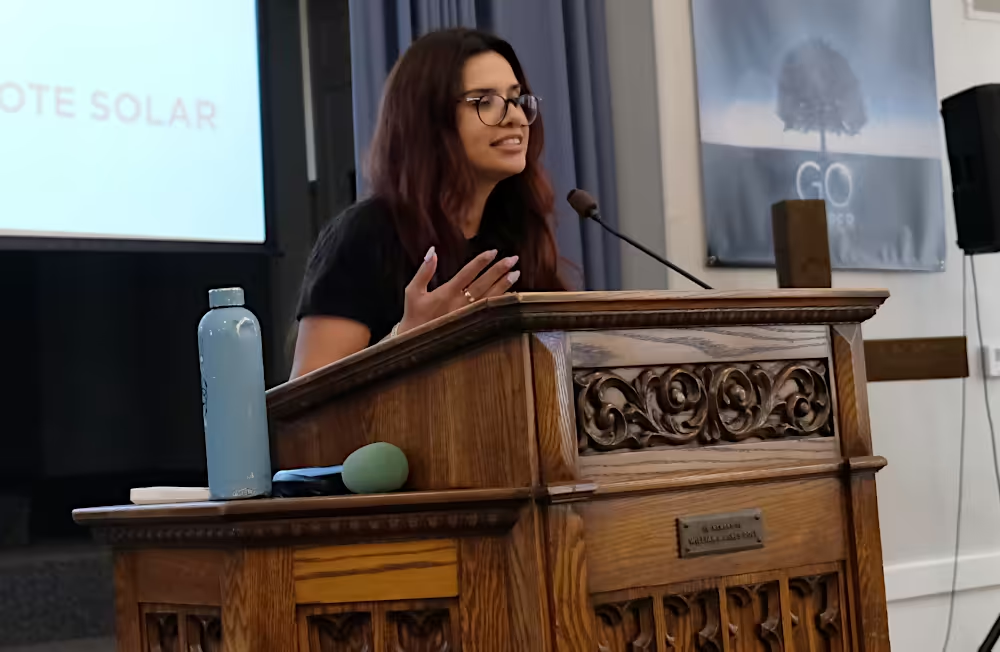 Lucy Contreras of Green Latinos introduces the POWER Act at Let's Talk Data Centers on August 13, 2026.“As data centers continue to expand across Chicago, we still lack the data and transparency needed to fully understand their long-term effects,” she said in a published statement on July 15, 2026.
Long-Vacant Property
“QTS has worked collaboratively with Alderwoman Ramirez and the City of Chicago for many years, and we look forward to continuing that engagement,” QTS said in a statement.
“Our campus gave new life to a long-vacant former industrial property,” QTS said. “We support thoughtful planning and community engagement … and are committed to responsible growth.”
Data Center Moratorium
The QTS statement pointed to the Commitment to Communities page on the QTS website, which outlines the company’s commitments to sustainability, transparency, economic impact, local communities and energy usage.
 An architect's rendering illustrates the appearance of the QTS Data Center expansion as seen from the South Ashland Avenue bridge in a slide presented at the August 26, 2024, development meeting.Ramirez joined Chicago Mayor Brandon Johnson on August 11, 2026, following his executive order for more data center oversight. Johnson also urged the Chicago City Council to pass a moratorium on new data center development.
Do You Use AI?
However, both the City of Chicago’s website and Ramirez’s the12thward.org website include services from AI company Google, which engages in AI-powered consumer surveillance tracking through code embedded in these websites.
Ramirez did not return multiple inquires about her Google integration and whether the 12th Ward or her reelection campaign uses AI or other services from AI companies.
Embedded Google Surveillance
In the Recommended Actions of its City of Chicago Roadmap for AI, the city stated its commitment to AI use, including establishing an AI lead and integrating “AI into the workplace as quickly as possible.”
The Prairie Rivers Network, Green Latinos and the Citizens Utility Board also integrate Google’s services into their websites.

AI Is the Cause
The Prairie Rivers Network has not made an official statement on their AI use, Rehn said. “It’s hard to avoid. We are still figuring it out.”
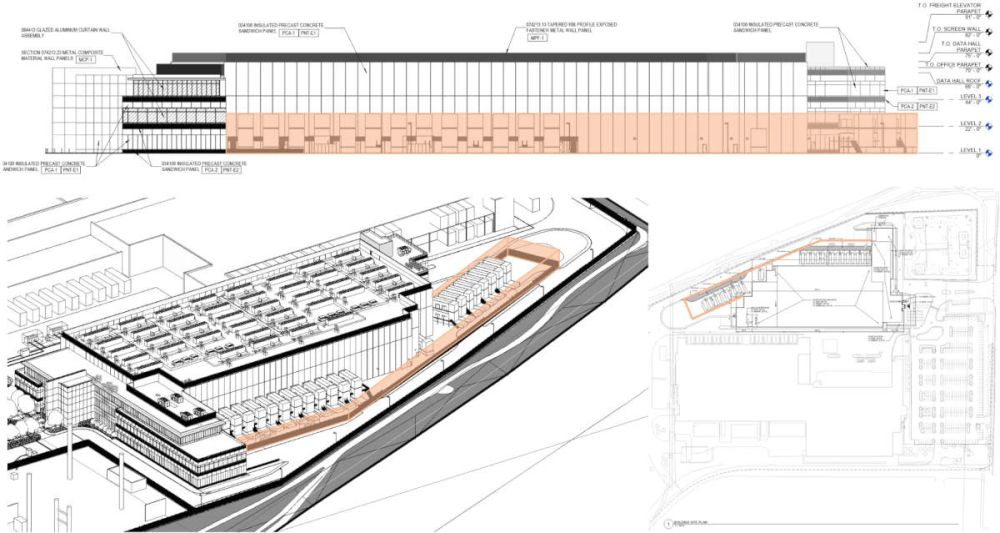 A slide at the QTS Data Center expansion meeting on August 26, 2024, illustrates the perforated screening wall to face the Chicago Sanitary and Ship Canal."The build-out of these data centers is due to AI,” Rehn said. “AI is an environmental issue.”
Getting Protected
Internet users can learn how to protect themselves from unwanted surveillance from AI companies through the User Technology Recommendations of the McKinley Park News.
Another user of services from AI company Google is Illinois 24th District State Representative Theresa Mah, who embeds Google’s surveillance tracking in her www.reptheresamah.com website.
Tax Subsidies
Mah, along with other state representatives and senators, including Illinois District 1 State Senator Javier Cervantes, who also embeds services from Google in his www.senatorcervantes.com website, signed a May 29, 2026, letter calling for a pause on data center tax subsidies. These have totaled over $983 million from 2019 through 2024, the letter said.
Jaimes noted that existing data centers receive seven years of tax reductions, and the requested pause would only affect new data centers.
Damen Silos Lot
QTS remains interested in continued engagement, Erwin said.
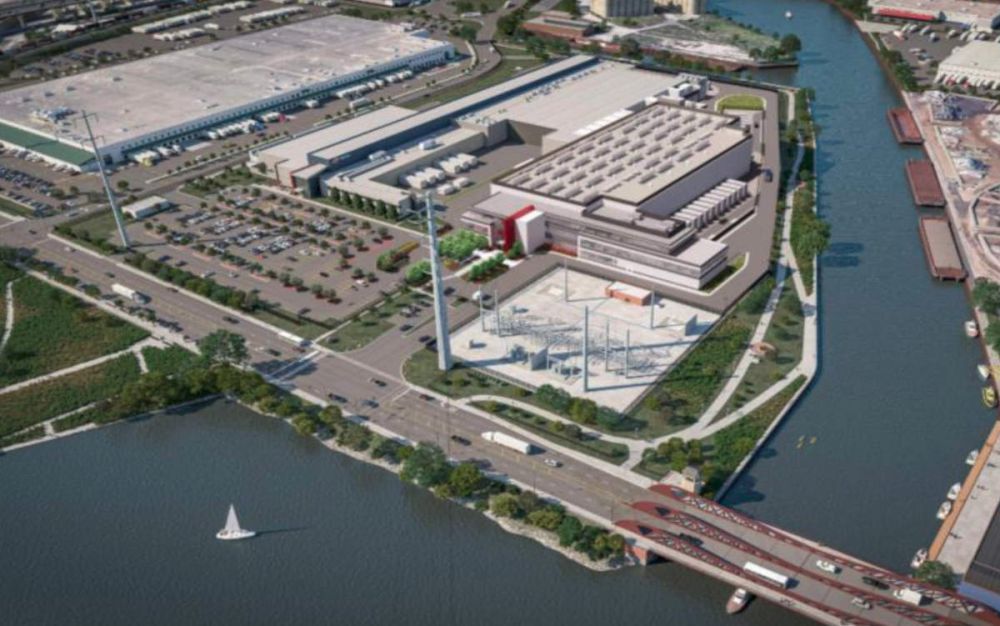 An aerial illustration shows the layout and buildings of the QTS Data Center expansion as presented at the August 26, 2024, development meeting.The temporary, newly constructed parking lot adjacent to the QTS campus on the former Damen Silos site is being employed as a staging area for data center construction equipment.
Construction Permit Approved
In a statement on June 26, 2026, Ramirez said she contacted the Chicago Department of Planning and Development to issue a violation letter “to stop using the parking lot until the site is brought into compliance.”
On August 6, 2026, the City of Chicago approved a two-year building permit for temporary construction trailers and portable toilets, retroactive to July 17, 2026, on the parking lot of the former Damen Silos site.
Passing the POWER Act
Prairie Rivers Network notes that the POWER Act (Senate Bill 4016 and House Bill 5513) still has a chance to pass during the fall 2026 Illinois General Assembly veto session and encourages citizens to contact their legislators to encourage support.
“Town halls are an important element,” Contreras said. “We’re mobilizing people who really care about the issue.”


Google is now, proudly, an AI-first company and AI industry leader that touts the integration of AI throughout all of its products and services. All of the consumer surveillance data scraped from Google Analytics and other integrations are fed into a massive, unregulated surveillance machine now powered by AI integration and features. For example, Google uses your Gmail messages to continually train its AI.
There are many ways to get the equivalent of Google's tools without exposing your users to unwanted surveillance and mal-activity, even for a tiny outlet like the McKinley Park News. Learn how to do so in our Letter from the Editor "Adieu, Google" at https://mckinleypark.news/about/letter-from-the-editor/4840-adieu-google
More importantly, this is a matter of rethinking how energy is created, generated, and distributed. It requires a mindset shift away from relying solely on traditional power infrastructure and toward more localized, resilient, and innovative energy systems.
Log In to comment on this item.
Subscribe
Report
My comments