


By Cook County Board of Review Commissioner George Cardenas
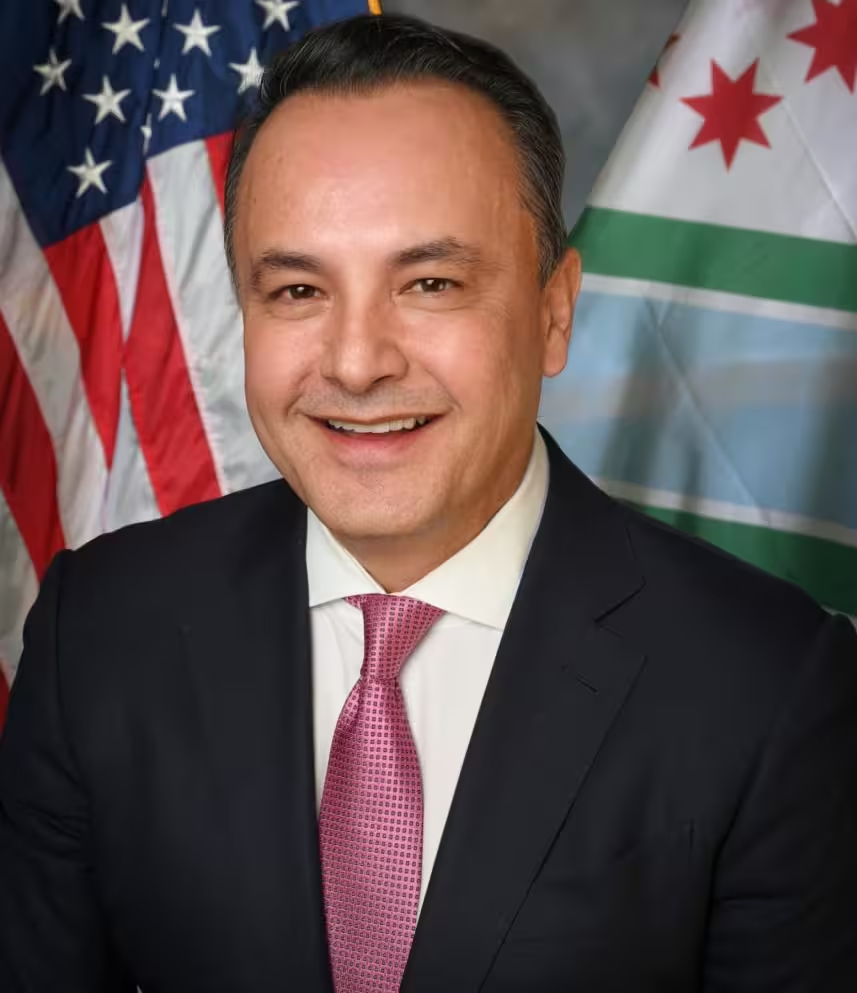 Cook County Board of Review Commissioner George CardenasAs a current commissioner for the Cook County Board of Review and a former Chicago alderman, I’ve witnessed firsthand the growing frustration among Chicagoans due to skyrocketing property taxes. City government has become increasingly reliant on this revenue source to fill budget gaps: a practice devastating for families and small businesses alike. As I visit neighborhoods like McKinley Park, I see and hear residents and shop owners who can only make partial payments and thus face a spiral into losing their homes and businesses.


A Fiscally Unstable Future
Chicago's 2025 Budget is desperately trying to fill a $982.4 million budget gap. With few revenue options left, property taxes once again loom as the likely plug in the ever-widening fiscal breach. This continued reliance on homeowners and small businesses to balance the city’s books has reached a breaking point. As a commissioner, I witness residents facing the threat of losing their homes due to unaffordable tax bills. This is not only a fiscal crisis — it’s a moral one.

Unjust Burden with Growing Risks
Year after year, Chicago leans on property taxes to cover pension liabilities and debt. Recently, costs included unchecked migrant spending. These increases occur with little regard for the mounting strain on taxpayers. Families are being squeezed to the point where paying their tax bills means sacrificing basic needs. Small business owners, already grappling with slim margins, are pushed to the edge. The Civic Federation has repeatedly warned that this strategy is a short-term fix with devastating long-term consequences.
Our City Council has been presented with a $345 million property tax levy increase, growing to $2.119 billion in 2025 from $1.774 billion in 2024. When combined with anticipated rises in property assessments from the 2024 triennial reassessment, Chicago taxpayers may experience more significant tax burdens than is being communicated through press releases. Taxpayers need to know how their tax burdens will increase.

As the Cook County Assessor’s Office finalizes the 2024 assessment, where are the public maps by city ward and city neighborhood that show taxpayers the new reality? Where are the simple hypotheticals that illustrate to taxpayers how much more they will have to save each month to pay the next 2nd installment tax bill? We have a moral obligation to the taxpayers, especially our seniors on fixed incomes, to show them the truth in a straightforward way.
Only One Piece to the Puzzle
The $345 million tax increase under discussion in the Chicago City Council is just one piece in a complicated puzzle. According to the Cook County Clerk, in the latest tax bill, the city’s portion of the tax bill was approximately 25 percent. We have an obligation to taxpayers to show them a complete picture of how much is being asked of them, specifically what more is being asked for by the Chicago Public Schools, which accounts for more than 55 percent of the tax bill.
In the last tax bill, the major governments asked for more than $6.97 billion. How much will taxpayers be asked for in the budgets being discussed and into the future? We need to paint a complete picture for the taxpayers, not a rough sketch.
Efficiency, Transparency and Accountability
To address Chicago’s financial struggles, we must prioritize fiscal accountability through regular efficiency audits and enhanced transparency. Cities like New York have set a standard with initiatives like Checkbook NYC, a platform that openly tracks municipal spending. This allows citizens to see how funds are allocated and helps identify inefficiencies.


Similarly, Los Angeles County’s audit division conducts periodic reviews, identifying waste, fraud, and opportunities for streamlining processes. San Francisco’s anti-fraud initiatives, which include hotlines and departmental education programs, provide an added layer of vigilance.
Chicago can and should implement a similar system, perhaps through a dedicated Office of Risk Management, that continuously monitors city expenditures, conducts routine audits and applies Lean Six Sigma principles to refine city operations. These steps would not only promote responsible spending, but also ensure taxpayer dollars are used effectively.
Now Is the Time for Bold Leadership
Too many Chicagoans have already been taxed out of their homes, and as I stated above, this isn’t just a fiscal crisis: It’s a moral crisis too. Government exists to serve its people, not price them out of their communities. Our city’s over-reliance on property taxes must end. I call on elected officials, business leaders, and residents to demand change. We need urgent reforms to diversify revenue, manage crises effectively, and ensure long-term fiscal sustainability.
Chicago’s future depends on it. Together, we can create a city where people can afford to live, work, and thrive. The time for bold leadership is now.


Log In to comment on this item.
Subscribe
Report
My comments