


Although the South Fork of the Chicago River (Bubbly Creek), borders the eastern portion of McKinley Park, there is no direct river access point within the neighborhood. Moreover, the waterway faces environmental challenges, which hinder recreational opportunities. Because of this, community members have identified the Chicago River as an underutilized asset. Historically, animal waste from nearby meatpacking industries contributed to Bubbly Creek’s environmental degradation. Today, combined sewer overflows (CSOs) are the main source of Bubbly Creek’s pollution. Large storm events often overwhelm the city’s wastewater system, and CSO waste is discharged directly into the Chicago River. The recently completed McCook Reservoir project is one initiative that aims to reduce sewer overflows in Chicago’s waterways. The project is a key component of the Metropolitan Water Reclamation District’s Tunnel and Reservoir Plan, and provides 3.5 billion gallons of storage capacity to capture flood water and waste from combined sewer overflows. With the increased capacity of the McCook Reservoir, CSO pollution of Bubbly Creek can be significantly reduced, making ecosystem restoration possible. In October 2018, the U.S. Congress passed a bill called the America’s Water Infrastructure Act, which includes a restoration project of Bubbly Creek. This requires the U.S. Army Corps of Engineers to enter into an agreement with the U.S. Environmental Protection Agency to facilitate Bubbly Creek ecosystem restoration. The restoration activities would address problems such as stream channelization, poor quality sediment that supports invasive species, lack of riparian habitat, and lack of diverse aquatic life.
Remediation of Bubbly Creek is an important component of improving recreational opportunities and connecting McKinley Park residents to the waterway. Currently the Eleanor Boathouse, located in neighboring Bridgeport, is the nearest access point for utilizing the river. However, better access to the South Fork of the Chicago River is proposed in the citywide Our Great Rivers initiative, a unifying and forward-looking vision for all three of Chicago’s rivers.
Great Rivers Chicago
Led by the Metropolitan Planning Council, the City of Chicago, Friends of the Chicago River, and CMAP, Great Rivers Chicago is an initiative to create a vision for the Chicago, Calumet, and Des Plaines Rivers. The initiative recommends actions for the public and government to take in order to make the rivers inviting, productive, and living by 2040. Several goals to achieve the vision focus on improving the water quality of the rivers to make them swimmable, litter- and odor-free, and habitable for plants and wildlife. Recommended actions include providing real-time water quality monitoring, developing operations plans, and making capital investments to ensure safe water quality.
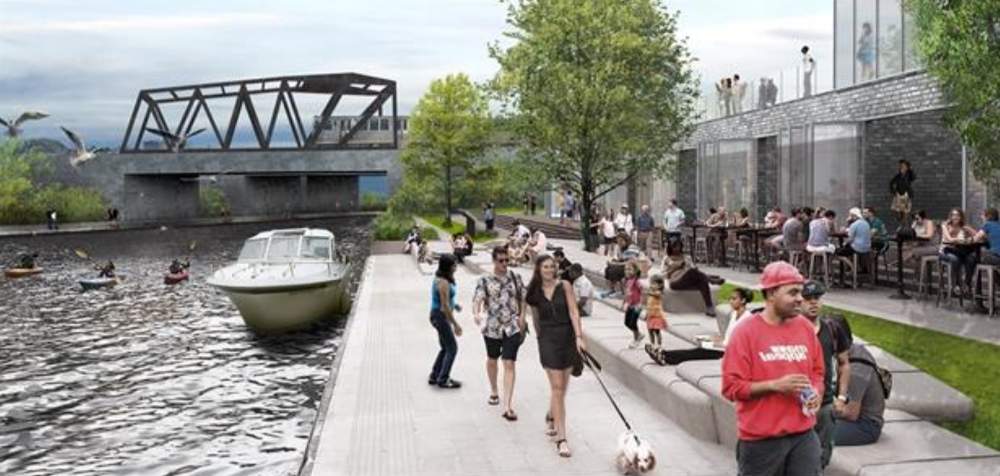
One of the proposals of Our Great Rivers is a mixed-use development on a vacant parcel at the mouth of Bubbly Creek that would improve access to the river for McKinley Park residents. The proposed development would feature housing, retail, and riverfront recreational opportunities that could create a riverfront destination and transit hub. The proposal includes a pedestrian connection to the Ashland CTA Orange Line station, as well as the Ashland Ave and 31st St buses. Moreover, a water taxi stop would connect the development to the Canal Origins Park and the Eleanor Boathouse via a pedestrian bridge over Bubbly Creek.
Figure 9.1 Rendering of proposed mixed-use development at Bubbly Creek
Source: greatriverschicago.com










Log In to comment on this item.
Subscribe
Report
My comments