


McKinley Park has long been a diverse neighborhood not only in terms of culture and ethnicity, but also in terms of income and the built environment. The area has benefited from having a wide range of housing options, such as rental apartments in large multifamily buildings, two- to four-flat buildings offering cheaper basement and garden units, historic bungalows, and large single-family homes. The variety of housing options has helped newly arrived and low-income residents remain in the neighborhood as their families grow and their finances improve. The neighborhood’s housing choices offer a ladder – from low-cost rentals to home ownership – while allowing the continuity of staying close to the same schools, places of worship, social services, and familiar neighbors.
In stakeholder interviews, community meetings, and survey responses, many expressed a concern that the current or future trends in the area will narrow housing options for residents of McKinley Park. Several cited quality, affordable housing as a priority need for the area. “The neighborhood is traditionally affordable,” said one resident, “but rents are rising.” A longtime resident reported, “McKinley Park is a ‘hidden gem’ and everyone is eyeing homes here right now,” and pointed to rising rents elsewhere in the city and the neighborhood’s appeal as causes. In many cases, stakeholders cited rapid recent developments in nearby neighborhoods such as Pilsen, Little Village and Bridgeport, fearing that the similarly strong affordable housing stock and access to transit in McKinley Park will make displacement of longtime residents inevitable.
- About 62 percent of housing units in the study area are in multifamily buildings, and 87 percent are renter-occupied. The diversity of housing options has been a source of stability, allowing residents who may initially rent smaller units to move up to larger units, and eventually to homeownership.
- While housing costs have increased since the 2008-era recession, McKinley Park prices remain low compared to other neighborhoods in the city. Preserving and creating opportunities for affordable housing will help protect existing residents against market pressures that could burden or displace residents.
- Households spending more than half their income on housing are considered severely cost- burdened. Based on data specific to the McKinley Park community area in the period from 2012 and 2016, 38 percent of owner households and 53 percent of renters are burdened by housing costs. This impacts their ability to spend money and support local businesses, as well as other daily necessities like health care.
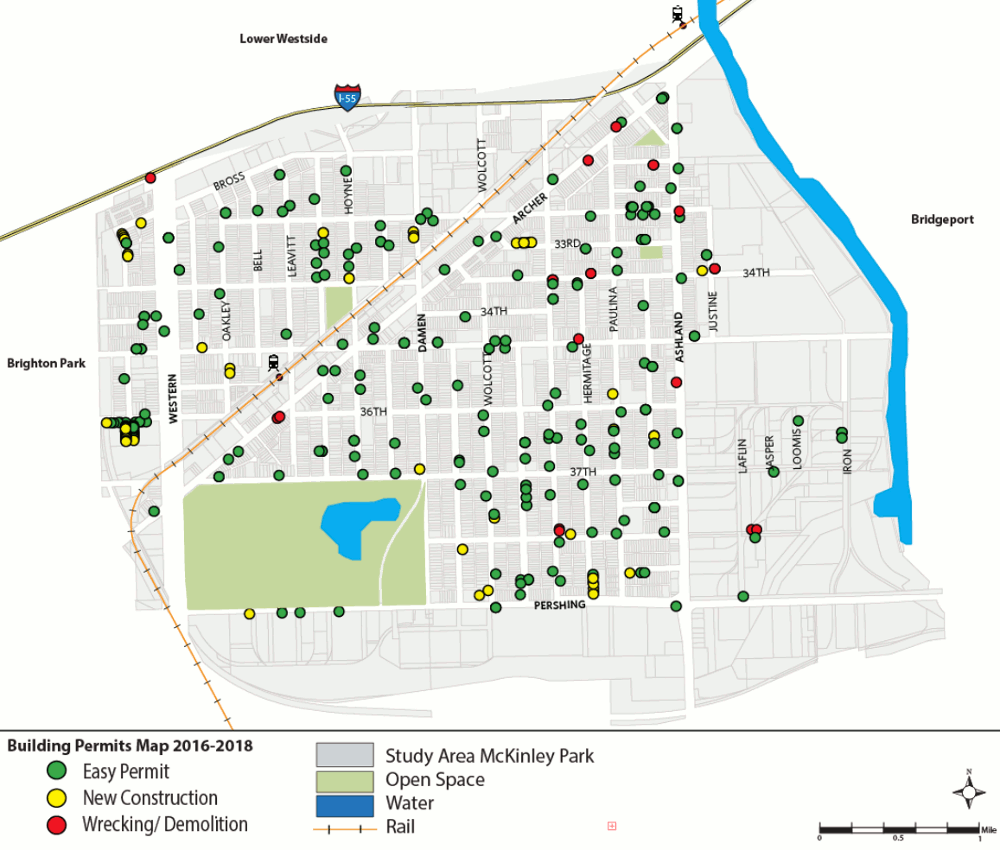
- The neighborhood features a large amount of older but high-quality housing. About 65 percent of housing stock in McKinley Park was built before 1940. An analysis of building permit data shows easy permits as the primary type of permit request in the community. Easy permits are primarily for improvements/renovations, which have taken place at an even distribution throughout the community. New housing construction in the study area is concentrated on the outer edges of the neighborhood, along Pershing Road, west of Western Avenue, and near Archer Avenue.
The major driver increasing interest in living in McKinley Park is the wealth of opportunities, good quality affordable homes, transportation options, and proximity to major employment centers. The study area offers easy access to downtown and Midway Airport via the CTA Orange Line, as well as to suburban job centers via the Stevenson Expressway (I-55). The excellent transportation offerings in McKinley Park puts a large number of jobs within reach of area residents, whether or not they have access to personal automobile.
The neighborhood features a large amount of older but high-quality housing. The majority of homes in McKinley Park were built before 1940 (64.5 percent) with only very few built in recent years (6 percent, built since 2000).
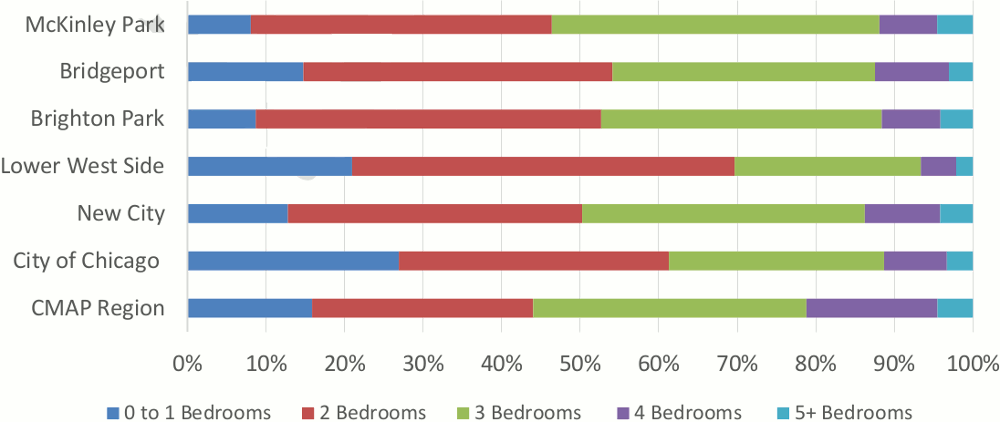
Beyond these attractive options for homeownership, McKinley Park has historically offered many options that are accessible for renters, lower income residents, and recent immigrants. About 62 percent of housing units in the study area are in multifamily buildings, and 87 percent are renter-occupied, similar to most surrounding community areas. Large apartment buildings and garden or basement units of smaller multifamily buildings offer a range of less expensive housing options, including units with sufficient space for families. About 8 percent of McKinley Park units are studios or have one bedroom, 38 percent have two bedrooms, and 42 percent have three bedrooms.
This distribution of housing unit sizes is similar to what is found in many nearby community areas, with the total percentage of 0-3 bedroom units comparable to all communities but Lower West Side (although the study areas has a higher percentage of 2-3 bedroom units than does the Lower West Side), see Figure 8.3. Overall, the diversity of housing options in McKinley Park has been a source of stability, allowing residents who may initially rent smaller units to move up to larger units, and eventually to homeownership.
Figure 8.3. McKinley Park Housing Size, 2012-16
Source: CMAP Analysis of American Community Survey Five-year Estimates 2012-16
While many in the community shared concerns about rising rents and potential displacement, current data presents a more complicated picture.
Housing Rentals
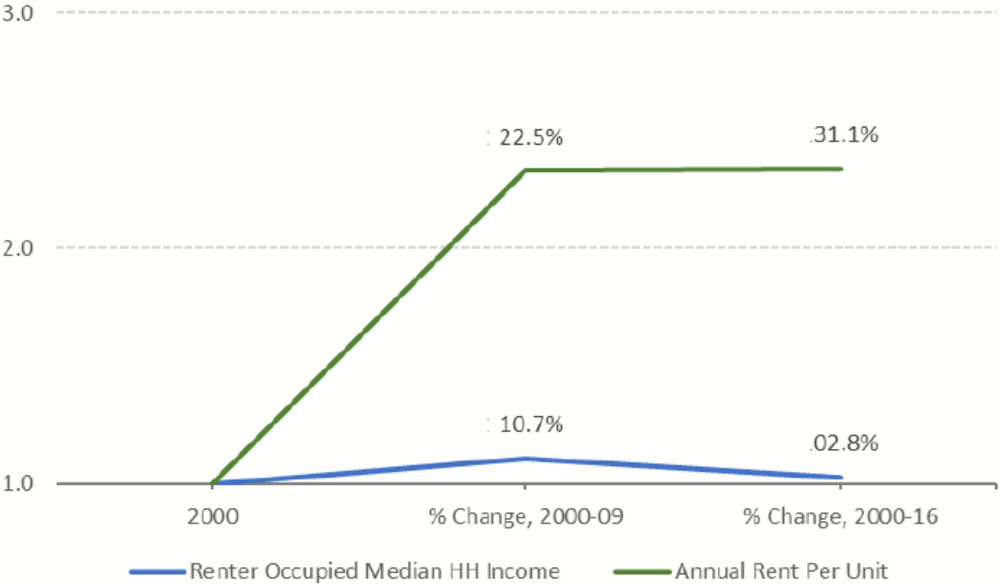
Overall, asking rents for multifamily properties in the study area over the last 16 years have increased, see Table 8.1. Average nominal rents in the study area have increased steadily by 22.5 percent from 2000 to 2009, and by 31.1 percent from 2000 to 2016. During this same period, the Median HH Income of renter occupied households has only increased by 10.7 percent and 2.8 percent respectively, see Figure 8.5.
Incomes in the neighborhood are not keeping up with the increased cost of living. In 2016, renters spent about 23 percent of their household income on housing cost, compared to 20 percent in 2009, and 18 percent in 2000. When adjusted for inflation, the household median income of McKinley Park residents is comparable, if now lower, than it was 16 years ago. People who spend a high percentage of their income in housing have less to spend locally at restaurants, retail, and overall day-to-day needs.
While asking rents have increased, the neighborhood’s rents remain low compared to other neighborhoods in the city.
Table 8.1. Renter Occupied Median HH Income, Annual Rent Per Unit, and Percent of HH Income Spent on Housing, 2000, 2009, 2016
| 2000 | 2009 | 2016 | |
| Renter Occupied Median Household Income | $28,990 | $32,090 | $29,804 |
| Annual Rent Per Unit | $5,124 | $6,276 | $6,720 |
| % of HH Income spent on Housing | 17.68% | 19.56% | 22.55% |
Source: CMAP Analysis of the 2000 U.S. Decennial Census data and American Community Survey Five-year Estimates, 2005-09 and 2012-16
Figure 8.5. Percent Change of Renter Occupied Median HH Income and Annual Rent Per Unit, 2000, 2000-09, and 2012-16
Source: CMAP Analysis of the 2000 U.S. Decennial Census data and American Community Survey Five-year Estimates, 2005-09 and 2012-16
Housing Sales
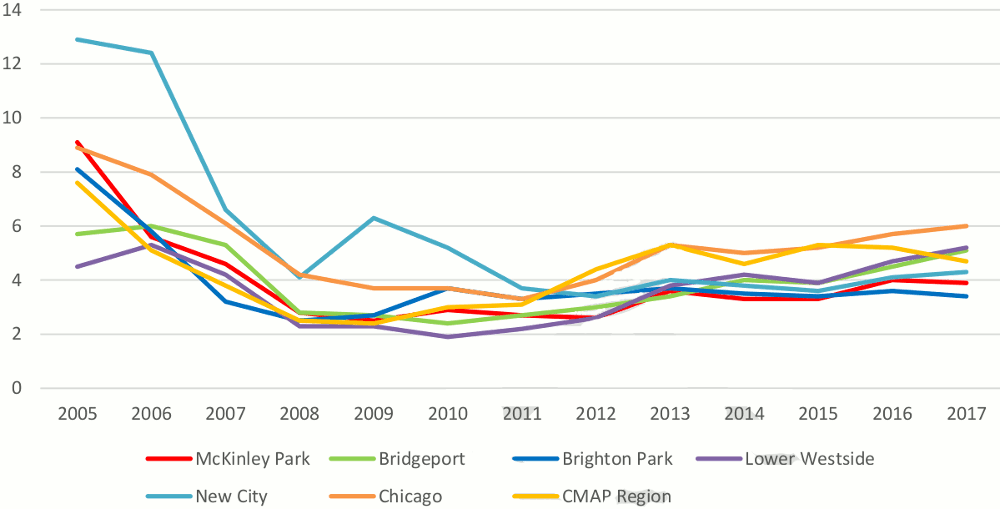
Housing sales activity in McKinley Park is very similar to that of other nearby communities, but the market is more sluggish than that for Chicago as a whole or the region (see Figure 8.5). The rate of home sales in McKinley Park remains below 2007 levels, but have increased slightly in recent years. Sales activity translates into changes in home prices. Based on the DePaul Institute for Housing Studies’ analysis of U.S. Census data, nearly half of owner-occupied homes (51 percent) in the neighborhood are valued at below $200,000, and an additional 44 percent are valued between $200,000 and $500,000. Under 4 percent of owner-occupied homes in the study area are valued more than $500,000.
Figure 8.5. DePaul University Institute for Housing Studies Residential Sales per 100 Parcels, 2005-17
Source: DePaul Institute for Housing Studies, 2005-17
Housing affordability is not only a matter of housing cost. Household income and housing-influenced costs, such as transportation, are also major factors in residents’ ability to afford to live in McKinley Park. As previously stated in Section 2, compared to the City of Chicago overall, the study area includes relatively more households with incomes between $15,000 and less than $75,000 a year. The median income is lower than that of Chicago overall but higher in the distribution of median incomes among nearby community areas.
Table 8.2 Household Income, 2016
| Median Income | |
| McKinley Park | $43,496 |
| Bridgeport | $42,630 |
| Brighton Park | $38,673 |
| Lower West Side | $39,020 |
| New City | $30,623 |
| Chicago | $50,434 |
| CMAP Region | $65,174 |
Source: CMAP’s Analysis of American Community Survey Five-year Estimates, 2012-2016
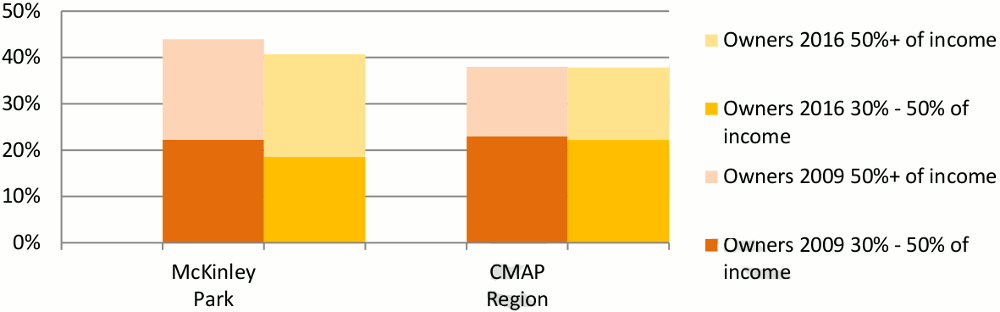
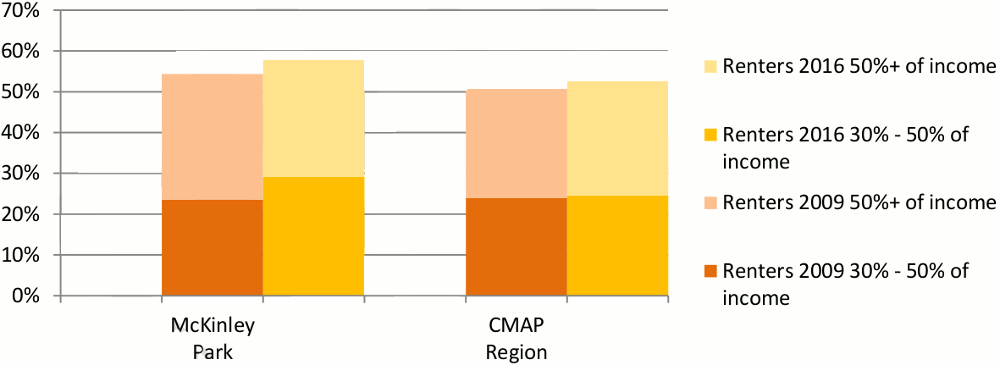
Households are considered to be housing cost-burdened if they spend more than 30 percent of their income on housing. Households spending more than half their income on housing are considered severely cost-burdened. Based on data specific to the McKinley Park community area, housing burden has moderately decreased for owner households in recent years (see Figure 8.7). In the period from 2012 and 2016, 38 percent of owner households were cost-burdened. A greater percentage (53 percent) of renters are burdened by housing costs. The greater proportion of income that residents spend on housing costs impacts their ability to spend money in other areas and support local businesses, such as retail, restaurants, leisure activities, as well as other daily necessities like health care. As a result, these households consequently may move out of the community to find other less costly housing options.
Figure 8.7. Percent of Owner Occupied Households Paying More than 30% of Income on Monthly Owner Cost
Source: CMAP Analysis of American Community Survey Five-year Estimates, 2005-09 and 2012-16
Figure 8.8. Percent of Renter Occupied Households Paying More than 30% of Income on Monthly Owner Cost
Source: CMAP Analysis of American Community Survey Five-year Estimates, 2005-09 and 2012-16
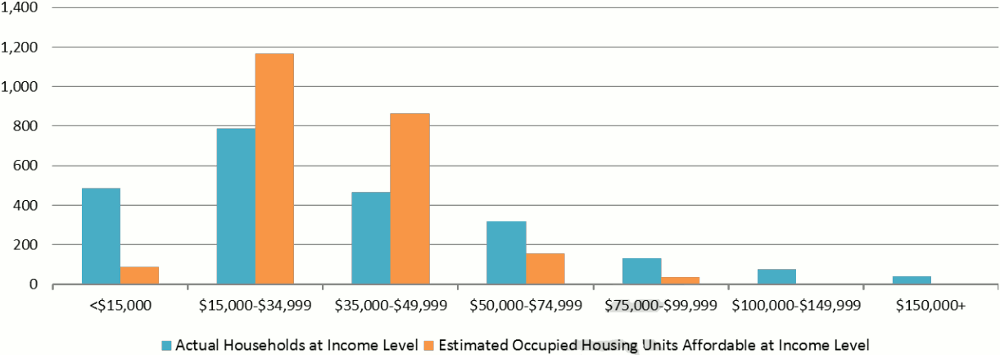
It is unsurprising that so many local renters are cost-burdened because many rental households earn less than $15,000 and there are very few local units affordable to households at that income level (see Figure 8.9). Instead, renters at this income level must struggle to pay for units affordable to households earning between $15,000 and $50,000 (of which there are many in the community).
Figure 8.9. Comparison of Rental Household Incomes with Occupied Units Affordable at Each Income Level, 2012-16
Source: CMAP Analysis of Fregonese Envision Tomorrow Balanced Housing Model using American Community Survey Five-year Estimates, 2012-16.
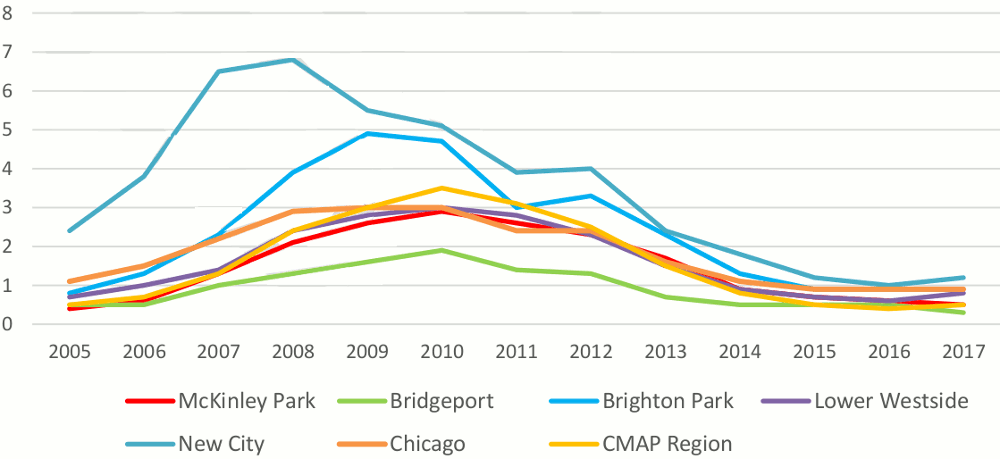
The post-2008 foreclosure crisis had a major influence on the study area’s housing market. Foreclosure filings in the study area increased from 2005 and peaked in 2010 at 2.9 per 100 residential parcels. Since 2010, foreclosure filings have steadily decreased, which leveled out the study area’s foreclosure rate with regional averages and lower compared to its surrounding community areas (except Bridgeport). As a result of the drastic increase in foreclosures between 2005 and 2010, the vacancy rate rose by eight percent between 2011 and 2015, according to data from the DePaul Institute for Housing Studies. Overall, McKinley Park has a lower vacancy rate than neighboring communities (Lower West Side and Bridgeport) and the city.
Figure 8.10. Total Foreclosure Fillings in McKinley Park, 2005-2017
Source: DePaul Institute for Housing Studies, 2005-17
An analysis of most recent permits for residential properties in the study area was analyzed to determine the intensity and type of investment happening in the community. Overall, the majority of building permit requests are for improvements/renovations (easy permit). Figure 8.11 illustrates an even distribution of improvements/renovations across the community with a few a demos (mostly concentrated in the northeast segment of the study area). The majority of new construction permits were requested for areas west of Western Avenue, along Pershing Road, and north of Archer Avenue.
Figure 8.11. Building Permit 2016-2018
Source: Chicago Data Portal
The wide variety of housing options in McKinley Park has long driven its diversity. By offering multi-family apartments and single-family homes for rental or purchase, close to transit and high quality amenities, the neighborhood offers not just a port of entry for new immigrants, but the option to stay. To maintain the neighborhood’s ethnic diversity, preserving affordable housing options for young people, families, and seniors will be crucial.
While new development offers one route to providing affordable housing, maintaining existing housing is equality important. The plan will explore strategies for preserving currently affordable units and examine opportunities for future development, particularly in areas with great access to transit. The next section of the report explores the concept of Transit Oriented Development (TOD) with an equity framework to preserve the rich character and diversity of the community.








Log In to comment on this item.
Subscribe
Report
My comments