


THE VISION
We will achieve resilience in McKinley Park by making natural systems, economic, and social structures more durable for years to come.
Introduction
By creating a resilient community, McKinley Park can prepare for and recover from acute shocks and chronic stress es both within and outside of the neighborhood. This requires making infrastructure, natural systems, and economic and social structures more durable. In addition to rebounding quickly from, for instance, stronger storms and frequent flooding, the community can actually capitalize on these challenges. By pooling resources, deploying new technologies, and strengthening local capacity, McKinley Park can plan collaboratively to provide essential services even as federal and state support continues to diminish. Our economy and the vitaliy of our skilled workforce to enhance access and services and improve future pathways to middle-wage job opportunities can also promote resiliency.
- One-inch rain events typically yield ten million gallons of runoff per block in McKinley Park, particularly along Archer Avenue and the industrial districts. If Chicago’s combined sewer system is not able to handle this runoff, it could overflow into streets, yards, and basements. Experts expect the frequency and intensity of large storms to increase in the future, which will continue to put the community at risk.
- 55.4 percent of households in McKinley Park earn less than $49,999, compared to 47.8 percent in the city and 38.1 percent in the region. One factor that influences income levels is educational attainment; only 13.8 percent of the population has a bachelor’s degree. The strategies in this chapter will identify how community leaders and stakeholders can align local economic development with education and workforce development opportunities to ensure every resident has the ability to fully contribute to and benefit from the economy.
- McKinley Park’s proximity to the Loop, commercial corridors, strong transportation network, and neighborhood charm are all assets that the community can use to stimulate and grow the local economy. Although there has been a decline in jobs within the neighborhood, 65 percent of McKinley Park residents are currently in the workforce, so there is potential to revitalize local employment through work force development programs aimed at local residents.
- Although the residents of McKinley Park are passionate and involved, there is an opportunity to elevate MPDC’s role with capacity building and the organizational tools to implement the neighborhood plan. MPDC members want to learn how they can build capacity among themselves and other community groups so that they can work together to make improvements within McKinley Park that will work together to make improvements within McKinley Park.
The strategies in this chapter are organized into three distinct areas — environmental, economic, and social — and aim to achieve resilience through green infrastructure, workforce development, and building community capacity, respectively. The recommendations will build upon the great work that MPDC has already done in an effort to keep the momentum going and get more people involved. MPDC should work in close coordination with city staff and the 11th and 12th Ward aldermen’s offices to implement these strategies.
A report produced by the Center for Neighborhood Technology (CNT) found that one-inch rain events typically yield 10 million gallons of runoff per block in McKinley Park, with the most affected areas being Archer Avenue and the industrial districts (see Chapter 10 of the existing conditions report for a detailed analysis on stormwater). As stormwater finds its way to the Chicago River, it flows down streets and through industrial areas, picking up oils, debris, road salts, and other harmful pollutants.
In 2016, the city of Chicago published a Stormwater Management Ordinance Manual that offers a set of best management practices to control the stormwater-related impacts of development and redevelopment in the city. The city also has several key initiatives that address stormwater and are available to McKinley Park residents. Many of these are pioneering the use of green infrastructure approaches and have gained national attention.
To mitigate the negative effects of stormwater, the neighborhood plan recommends that MPDC, with support from the aldermen’s offices, promote and pursue existing citywide green infrastructure programs.
Recommended City of Chicago initiatives include:
- The Green Roof Initiative: Program awarding grants to residential or commercial projects to install a green roof.
- Green Alley Program: Program aimed to redesign city alleys for stormwater infiltration and storage using permeable pavement to capture stormwater.
- Basement Flooding Partnership: Partnership reated to provide technical support to communities challenged with localized flooding.
- Private Drain Repair: No-cost repair service to homeowners who can prove they have broken tiles in lateral lines between the sidewalk and the main sewer line.
- Space to Grow: Program aimed to transform Chicago schoolyards into vibrant green spaces while effectively managing stormwater. Led by Openlands and the Healthy Schools Campaign with funding from Chicago Public Schools, The Metropolitan Water Reclamation District of Greater Chicago, and the Chicago Department of Water Management.
Images 8.1 Green Alleys in Chicago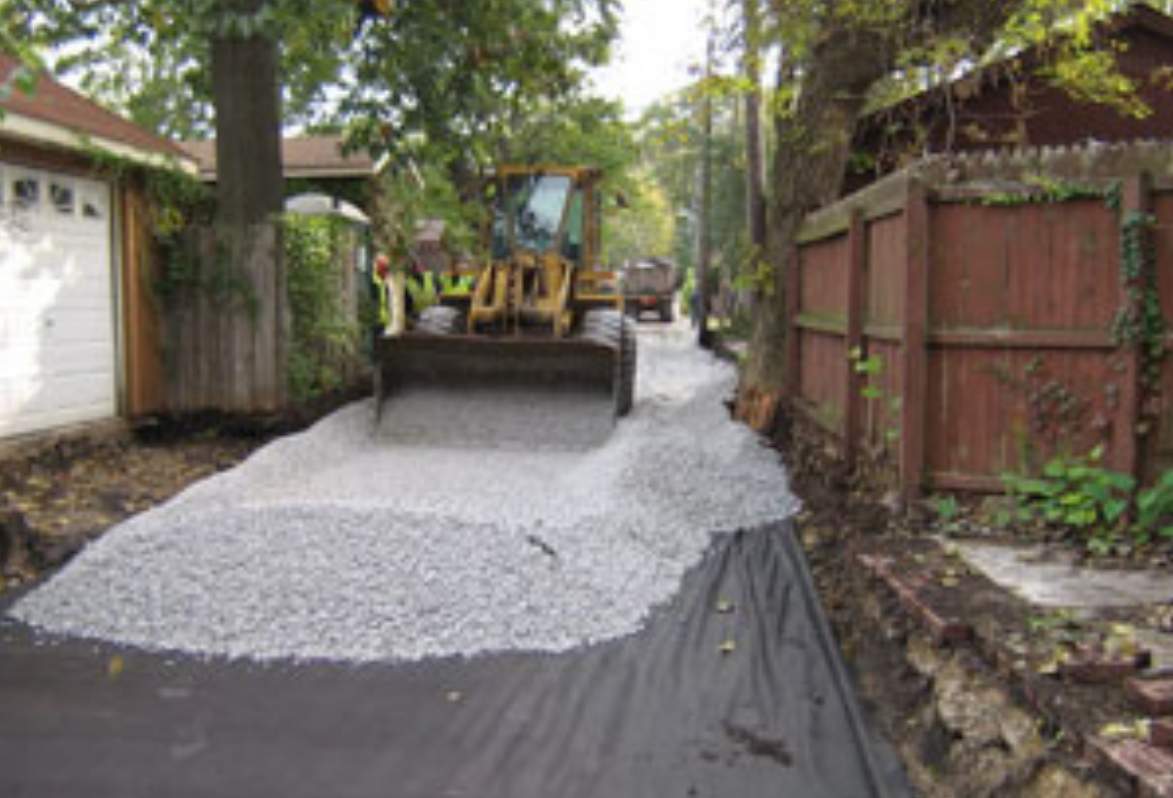
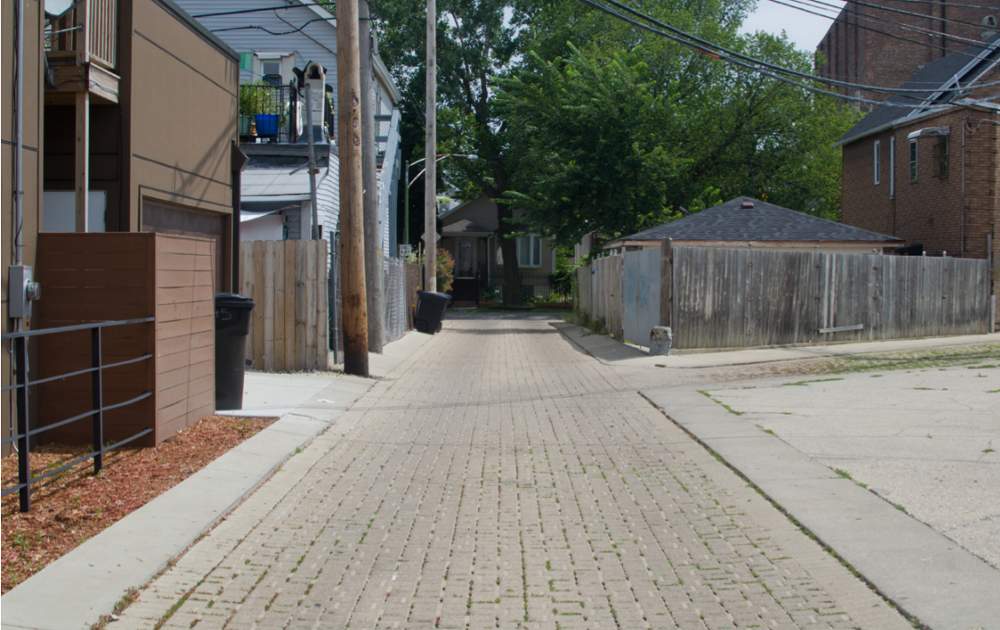
Source: City of Chicago
Case Study: El Paseo Community Garden
Located in Pilsen, El Paseo Community Garden was founded in 2009 and provides an example of how vacant space can be transformed to benefit the surrounding community. It is a Neighborspace-protected and community managed space, maintained by volunteers. Gardening is offered to residents through private allotment beds or collective beds. The garden is located on a former brownfield site and was constructed during the first phase of “El Paseo,” a rails-to-trails project. The garden features beautiful public art including El Abrazo Mural (pictured), the Shed Installation by Chip Thomas, and the Loomis River Bridge. The garden also puts on volunteer days, educational gardening workshops, potluck parties, and annual harvest festival, a Halloween haunted garden, pop-up markets, weekly yoga, and weekly meditation.
Work with city and local organizations to identify vacant land that is appropriate for green infrastructure projects in public or community managed open spaces
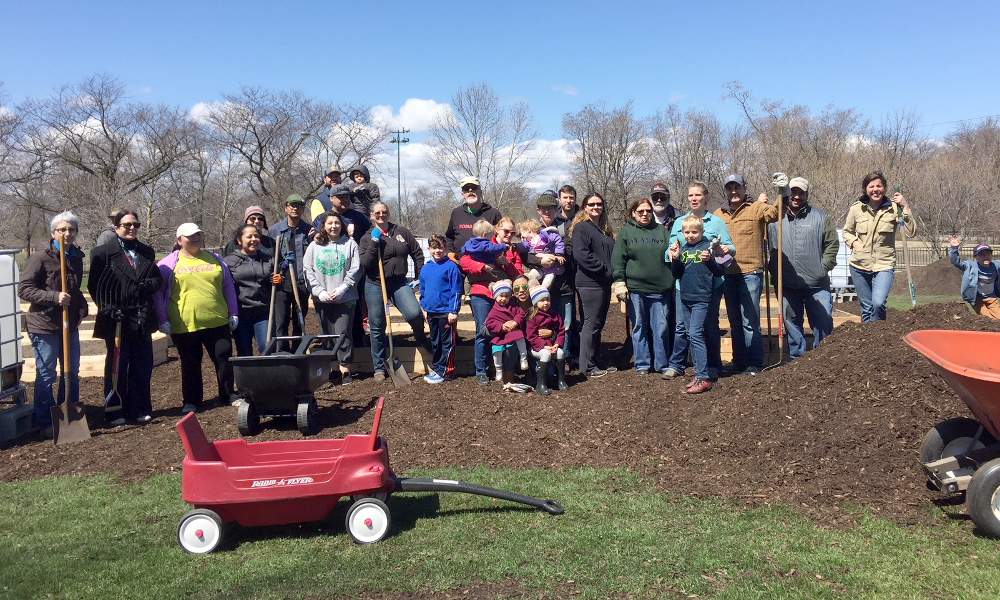 From "Community Gardeners Finish New Site Buildout," published April 30, 2018, in the McKinley Park News.Vacant land in McKinley Park accounts for 6.6 percent (53.8 acres) of the overall land use. While robust redevelopment is desired in all zones over the long term, in the interim there are several strategies for repurposing vacant residential lots for uses other than new housing. For example, the McKinley Park Community Garden had its original home in a private, empty lot before relocating in 2016 to a new, permanent location that was approved by the Chicago Park District. Such strategies can improve quality of life while helping improve the local market and feasibility of future development. Potential uses for currently vacant lots include:
- Urban agriculture (gardens, apiary) and community gardens
- Community gathering and event spaces
- Expanded side lots for existing homes
- Temporary sports lots and play spaces
- Green infrastructure for stormwater management
- Public art
Incorporate stormwater landscapes along designated bike routes within the neighborhood
Identify strategic locations along designated bike routes and on city-owned land to develop stormwater landscapes as part of the Department of Water Management’s Green Stormwater Infrastructure Strategy. The plan recommends that key improvements focus on the main corridors that run through McKinley Park, such as Archer Avenue, 35th Street, Western Avenue, and Pershing Road, for such treatments as sidewalk tree pits that capture street runoff, parkway bioswales, rain gardens, and permeable pavement parking lanes. By integrating green infrastructure into streetscape projects, McKinley Park will be in a much better position to reduce flooding in future storms and protect the environment going forward (see strategy 5.2d).
Partner with the Illinois Green Alliance’s Youth and Green Schools initiatives to implement carbon drawdown strategies
The Illinois Green Alliance’s Youth and Green Schools initiative offers several programs that encourage students to promote sustainability within their own communities. For example, the Green Apple Day of Service brings parents, teachers, students, companies, and local organizations together to transform schools into healthy, safe, and productive learning environments through local service events. The initiative also has a program called Green Ribbon Schools that recognizes schools that promote and educate people about sustainability through events, actions, or programs. The neighborhood plan recommends that MPDC reach out to this program to inquire about opportunities to partner.
A low-lying topography, changing climate, development and associated impervious surfaces, and an aging sewer infrastructure contribute to urban flooding within McKinley Park. Beyond the direct costs of property damage from flooding — carpets, furniture, and heating units — there are less direct costs; residents may lose valuable memorabilia, there are health and safety risks to children, seniors, and animals, and street flooding can damage parked cars and may hinder residents from traveling to work. To address this issue, MPDC should encourage neighborhood groups within McKinley Park to work together on implementing green infrastructure practices that reduce the heat island effect, mitigate stormwater, block traffic noise, and improve air quality. A multi-pronged approach would include applying for grants and citywide programs that provide green infrastructure guidance and materials, working with the alderman’s office to identify areas for key spot improvements, and educating the public on the importance of sustainability and how they can change individual behavior. These efforts will undoubtedly have a long-term, positive impact on McKinley Park.
There are a number of excellent green infrastructure programs in the city that can serve as resources to MPDC and the residents of McKinley Park as they consider ways to address climate change. The plan recommends that MPDC further explore and prioritize the following initiatives and programs with support from the local alderman:
- Chicago Downspout Disconnection Program: The City of Chicago actively encourages homeowners to disconnect their downspouts from the sewer system in order to slow the flow of stormwater into the sewer system, relieve basement flooding, and redirect water to yards and gardens. This practice should be encouraged in McKinley Park where flooding is a concern.
- Plant Chicago: Plant Chicago is a nonprofit organization that supports a collaborative community of small food businesses focused on growing, producing, and/or sourcing a variety of food products, while striving to close loops of waste and energy. Located in Chicago’s Back of the Yards neighborhood, just south of McKinley Park, Plant Chicago offers a variety of different K-12 education programs that revolve around sustainability and food production. They are also home to a robust farmers market that provides locally grown food.
- RainReady: This is a Center for Neighborhood Technology program that helps property owners and communities implement infrastructure improvements to address sewage backup, seepage and building dampness, and yard and street flooding. RainReady programs are designed with equity, affordability, resiliency, and community in mind.
- Chicago Tree Program: In an effort to increase the amount of trees in the Chicago region, the Bureau of Forestry plants trees along the public right-of-way throughout Chicago. Benefits of street trees include improved air quality, increased physiological well-being, noise abatement, and stormwater attenuation. Chicago property owners who want a new tree planted on their parkways can call 311 or submit a request online to register for this free city service.
- Streetscape and Sustainable Design Program: The Chicago Department of Transportation (CDOT) Streetscape and Sustainable Design program strives to rehabilitate Chicago’s neighborhood commercial areas, riverwalks, and bicycle facilities into active, attractive places for Chicagoans to live, work, and play. Using a variety of techniques, projects under this program aim to create flourishing public places while improving the functionality of infrastructure to support dense urban living.
Other Strategies
- Advocate for the targeted expansion of green stormwater infrastructure to reduce urban flooding
- Engage the community in flood mitigation solutions
- Create a youth-led neighborhood litter and recycling campaign
- Ensure clean energy and water efficiencies by connecting landlords to incentives and resources
- Implement sustainable practices in industrial areas (see Chapter 6 for strategies)
- Identify opportunities for urban agriculture
- Empower residents and organizations to create artistic, beautiful landscapes, and clean, environmentally diverse streetscapes (see Chapter 5 for strategies)
Case Study: Lincoln Square, Chicago — Lawrence Avenue Livable Streets Project
The livable streets project in Lincoln Square offers an excellent model for an environmentally diverse streetscape designed to mitigate flooding and beautify the neighborhood. The Lawrence Avenue streetscape was the city’s first road diet project designed to balance the modal use on Lawrence Avenue by providing wider sidewalks and completing the City’s longest designated bike lane street while also calming traffic and improving pedestrian crossings.
Improvements included new lighting, pedestrian refuge islands, narrowing the roadway, trees, bump-outs with bioswales, concrete bus pads, drainage improvements, resurfacing, and creating the Claremont Avenue plaza. The second phase of the Lawrence Avenue streetscape project will extend the streetscape from Western to the Chicago River and will build upon the success of the first section of the Lawrence Avenue streetscape.
McKinley Park’s proximity to the Loop and strong access to public transportation makes it a desirable place to live and work. An abundance of beautiful historical buildings present a great opportunity for development in the neighborhood. For example, Marz Community Brewing Co. in McKinley Park resides along an offshoot of the Chicago River, which has the potential to host a variety of water activities including kayaking, canoeing, and fishing. A formal business entity should be formed to serve as a resource, advocate, and convener for existing local businesses, while simultaneously working to attract new diverse businesses to industrial districts and the vacant storefronts along major commercial corridors. Increase the capacity of MPDC to support local economic development initiatives (Please see Recommendations 3.4 and 3.5 for detailed strategies).
Get expert advice on economic development
As local aldermen explore how to grow local employment opportunities in the industrial and advanced manufacturing sectors within their designated wards in McKinley Park, the plan recommends seeking advice from local economic development organizations that can provide insight and feedback to proposed developments. The Department of Planning and Development (DPD) spearheads several economic development initiatives, which include a wide spectrum of financial assistance programs, business development efforts, and related quality-of-life endeavors for local neighborhoods. DPD also provides funding to delegate agencies whose objectives include small business development, site development or area-wide marketing, maintenance and management within a specified commercial business district. Other resources include the Nathalie P. Voorhees Center for Neighborhood and Community Improvement, Local Initiatives Support Corporation (LISC) Chicago, and the Chicago Community Loan Fund.
Set up neighborhood tours to promote assets to prospective developers and businesses
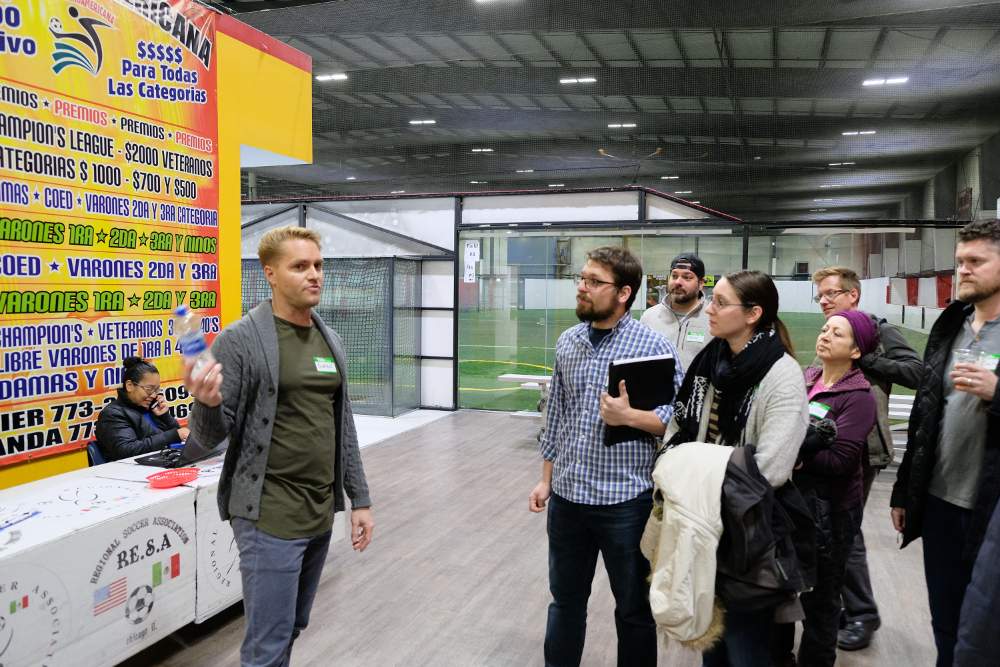 From "Development Council Tours Razzmatazz, Shares Program and Community Updates," published March 22, 2018, in the McKinley Park News.In an effort to market business and development opportunities in McKinley Park, MPDC should organize tours of the neighborhood that showcase local assets and potential. Tours can be designed to highlight some or all of McKinley Park’s many assets, including its transit-rich areas, natural amenities, local services, and properties available for purchase. Promotional videos and an online and social media presence could also showcase McKinley Park’s assets to the business community.
In order to prosper economically and sustain a high quality of life, McKinley Park needs to maintain a diversity of business types, a skilled workforce, and the capacity to adapt and grow. Preparing McKinley Park residents for good jobs requires access to a range of quality training and education programs for people with different educational needs. Local service providers should work together to ensure that all of McKinley Park’s residents have equitable access to education and career development opportunities.
Establish the role of a workforce development coordinator to identify resources and connect workforce training providers and educational institutions with employers
Preparing our residents for the jobs of the future is essential for them to stay competitive throughout their careers. McKinley Park already has a number of resources available for parents, students, business owners, and job seekers that residents can take advantage of. For example, the McKinley Park Library offers resources on becoming a citizen, homework help for children and their parents, computers and wifi, and materials available in Chinese and Spanish. Another resource is 36Squared, a nonprofit organization offering onsite training, classes, and one-on-one counseling to help local entrepreneurs grow their businesses. These types of services are abundant in and around McKinley Park — they just need to be more visible. In order to make residents more aware of these types of services, the plan recommends that these organizations market their programs more heavily within McKinley Park. It is also recommended that organizations collaborate and partner with one another on various events throughout the year to strengthen the workforce development network in McKinley Park. One idea is to host an annual workforce development day in McKinley Park that provides residents with the education, tools, and resources they will need in their careers.
Another resource that MPDC should consider is the Chicago Citywide Literacy Coalition’s (CCLC) career pathways navigator. The CCLC’s mission is to help Chicago’s adult education organizations secure resources and training so that underserved adult learners can become economically successful. The CCLC reframes adult basic education as a critical public policy issue. Their career pathways navigator is based out of the Near West American Job Center (AJC) in Pilsen and connects adults that enter the AJC to adult education services. They collaborate with 13 other organizations in the area, including A Safe Haven, Literacy Chicago, and Richard J. Daley College. McKinley Park residents can take advantage of their services as they work to gain the skills needed for employment.
Continue to support and coordinate English as a Second Language (ESL) training and new occupational programs
McKinley Park has some outstanding resources for ESL learners and job seekers.
- The Aquinas Literacy Center offers a variety of programs for English-language learners, including one-on-one tutoring, small group instruction, conversation classes, family literacy nights, and a summer program for children.
- National Latino Education Institute (NLEI) offers training programs that are nationally accredited, recognized, and approved by the Illinois State Board of Education and the U.S. Department of Education. Their goal is to provide quality workforce initiatives leading to economic independence for Latinos.
- The McKinley Park Library provides an array of resources and services, with community space and programs for all ages. Additionally, the library features Chinese-language and Spanish-language materials and a “Citizens Corner” that offers English as a Second Language classes, citizenship workshops, and a wide selection of materials on immigration and U.S. citizenship.
- The City of Chicago’s One Summer Chicago jobs program provides youth with employment and enrichment opportunities during the summer months.
- The Chicago Urban League offers a number of workforce development programs, such as the Transportation Construction Apprenticeship Readiness Training and a transitional job Training program in partnership with the Chicago Housing Authority.
Encourage businesses to hire local residents, and identify and address the barriers to doing so
There are many benefits to hiring locally. Local residents can more easily attend in-person interviews and likely have local references to provide recommendations. People who live in the neighborhood will also have a greater knowledge of local networks and resources. Having a local job also means shorter and often cheaper commutes. Lastly, people who live in the neighborhood will likely be more invested in the success of local organizations, schools, and businesses.
 From "ComEd Tools of the Trade Builds Hands-On Career Skills in Young Learners," published September 26, 2019, in the McKinley Park News.There are a few barriers to hiring locals that should be considered. First, people with the necessary job skills could be limited. The applicant pool will naturally be smaller in a local setting, and there might not be as many residents with specific work experiences and skills. Another potential barrier is that local applicants might not understand the company’s values or standard practices. Unlike an internal hire or a candidate with the exact qualifications and experience, there will most likely be a steeper learning curve for local hires, especially if they enter a new field of work. While this might require more training and effort initially, there is a greater chance of long-term success due to the benefits mentioned above.
The plan recommends posting job opportunities in central locations with high visibility, such as community job boards (typically found at local grocery stores, libraries, community centers, and schools) and online platforms that receive a lot of local traffic. Using local networks for recruitment purposes will better ensure that local jobs are going to people who live in the neighborhood.
Chicago Anchors for a Strong Economy (CASE) is an excellent resource for employers. Their mission is to create inclusive economic growth by leveraging the buying power of small businesses, community partners, and anchor institutions to collectively impact neighborhoods in Chicago. Using an online matchmaking software called SCALE, they assess businesses’ readiness to service large contracts and provide direct access to contract opportunities with anchor institutions. Anchor institutions near McKinley Park include the University of Illinois at Chicago, Northeastern Illinois University, University of Illinois Hospital, and Mercy Hospital and Medical Center.
The ultimate goal of hiring local residents is to ensure that people can access jobs near where they live. Living close to work has been proven to reduce traffic congestion, travel costs, and pollution; increase productivity; minimize stress; create a better work-life balance; and improve quality of life. Organizations, schools, and businesses should seek opportunities to hire locals when possible.
Other Strategies
- Expand access to City of Chicago services for McKinley Park’s residents with limited English proficiency
- Prepare residents for employment in growing sectors that offer middle- skill, middle-wage job opportunities
- Increase the impact of existing local wealth-building programs to help residents
The following strategies offer concrete and sincere ways to better engage and involve the McKinley Park residents in projects and decision-making surrounding the neighborhood plan. Successful implementation of the plan will rely in large part on community engagement to help inform which strategies to prioritize and the best ways to achieve them.
Create a framework for sustained, inclusive community involvement in planning decisions
Throughout the planning process for this plan, CMAP received great community input from a wide range of residents. The strengthening of partnerships with residents and community groups, including local institutions and businesses, should continue and build off the momentum of this planning process. A first step is to develop and maintain a database of community leaders and organizations who were involved in the planning process. The database should include contact information for key individuals within each entity and should be periodically updated in order to maintain its effectiveness for communicating with stakeholders about the neighborhood plan and engaging them in activities. A precise and up-to-date listing of community leaders and local groups will make it easier to recruit partners and volunteers for specific objectives that relate to this neighborhood plan.
Re-engage existing resident groups and facilitate the creation of new community groups
 From "Environmental Justice Group Launches as Counterpoint to New Industrial Development," published August 10, 2018, in the McKinley Park News.Residents will always be the backbone of the McKinley Park community. Supporting an engaged, informed, and active resident base will not only improve implementation of the neighborhood plan, but it will also create a network of participants to move future plans and activities forward. An outreach plan should be developed based on the objective of the neighborhood plan and the opportunities to engage various segments of McKinley Park’s diverse population. The planning process should be used to start the conversation with local community groups and use the plan’s implementation strategies to provide these groups with new energy and focus.
While it is important to reconnect with existing community groups, assistance should also be given to the creation and coordination of new community groups. There may be opportunities to create new community groups focused on some of the objectives of the neighborhood plan, particularly as these objectives relate to specific plan recommendations.
Continue to hold educational forums
Although MPDC members will become well-versed in the recommendations of this neighborhood plan, residents, stakeholders, and community partners may not be as familiar with its content. In the months following completion of the plan, it is recommended that educational forums be held throughout the community to introduce the topics, challenges, and implementation activities related to the plan. These educational forums can be held in conjunction with community meetings, events, or other activities that already attract residents and stakeholders. Prior chapters in this plan identify opportunities for potential new MPDC committee groups to help lead implementation of plan strategies.
Dedicate webpages to the neighborhood plan and use social media outreach
A dedicated webpage should allow the public to read the plan in its entirety, keep track of plan progress, and access information on community events related to the plan. This webpage should also house interim plan materials, such as the existing conditions report, in order to view maps, demographic information, and community engagement materials. MPDC should post the neighborhood plan on its website, and provide updates to users through social mpedia and community newsletters.
Another component of a resilient community is the residents themselves. The contributions of residents, businesses, and organizations in McKinley Park make the community stronger. Having a strong network of residents connected through a shared love for the neighborhood not only contributes to its character but also promotes a sense of respect, dignity, engagement, collaboration, and livelihood among neighbors. This strong sense of community exists within McKinley Park. Enhanced local capacity will help McKinley Park address future challenges and opportunities as well as longer-term projects, such as plan implementation. To this end, the plan seeks to get more people invested, engaged, and involved with the many commercial, cultural, and recreational opportunities within McKinley Park.
Build trust and collaboration with residents
Developing strong partnerships with organizations can help enhance cooperation and utilization of the existing capacity, expertise, and knowledge of community-based organizations. To do this, an up-to-date list of local existing businesses and institutions should be kept and individuals should become familiar with the services they provide. Local business and community meetings should be used to keep these groups informed, and support should be given to efforts to develop community leadership and participation. Potential organizations include:
- Property and business owners
- Industrial and commercial organizations
- Religious leaders and members
- Community groups
- Consulates
- Arts and cultural organizations
- Ethnic media
- Health organizations or centers
- Leadership, organizing, or advocacy groups (Asian and Latino)
- Parks, schools, and libraries
- Unions
Promote civic engagement
Turnout in local elections affects government spending priorities. By encouraging groups that have had historically low representation at the polls, priorities can start to reflect the real needs of the community. Encouraging participation in municipal elections leads to a stronger, more representative government. There are a number of strategies that can be used to increase voter turnout, such as posting election reminders in email newsletters, partnering with community groups to host meet and greets with local candidates, and working with schools to hold mock elections for local students to get young residents interested.
Organize community-building activities
In many cases, the most effective way to engage residents is through community events. Block parties, street fairs and festivals, and community gardens can all help bring different groups together and help residents feel more integrated. A number of community events are already being held, and these can be used as opportunities to bring different segments of the population together. Partnerships, including advisory boards, the alderman’s office, local school councils, and community groups, should be used to figure out ways to engage diverse groups of residents in the process of designing, planning, and hosting year-round community activities in McKinley Park.
Components could also be added to existing events to help draw different audiences. Additional new events could be more low-key. For instance, the Village of Skokie has sponsored “Know Your Neighbor Week,” during which residents are encouraged to invite their neighbor over for coffee in their homes. The village provided hosts with kits that included invitations, conversation starters, and coupons to local bakeries.
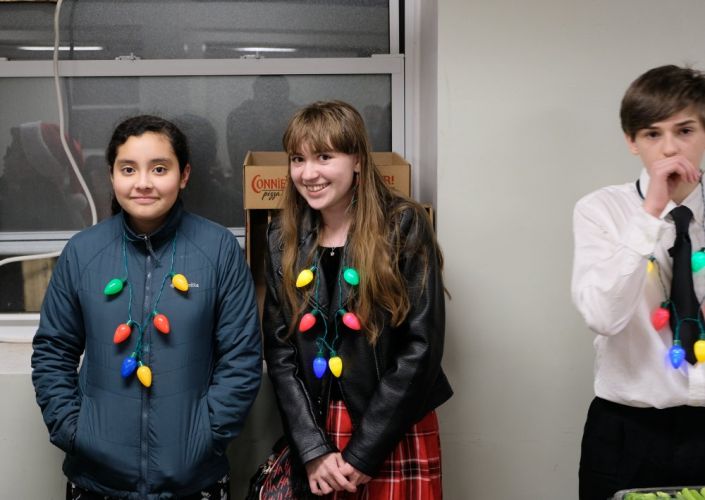
From "Holiday Parties Brighten the McKinley Park Neighborhood," published January 6, 2020, in the McKinley Park News.
CAPS Beat 912 Christmas Party
Beat 912 of the Chicago Alternative Policing Strategy (CAPS) celebrated the holidays with the group's annual Christmas party on Thursday, December 12, 2019, at St. Maurice Church hall. The gathering marked the last time that beat facilitators Glenn and Christine Young would host a Beat 912 gathering, as they are stepping down after 26 years of leadership and service.









Center for Neighborhood Technology (Rec 8.1)
The Center for Neighborhood Technology (CNT) is an organization that works to make cities more sustainable while raising the quality of life for vulnerable populations. Initiatives in transportation, water, climate, and public policy advance these goals, while research and consultations with City leaders and decision makers help find solutions to challenges. CNT also develops a host of data tools and analyses that help policymakers make more informed decisions about how best to support and enhance livability of a community.
https://www.cnt.org/
Chicago Citywide Literacy Coalition (Rec 8.4)
The CCLC mission is to help Chicago’s adult education organizations secure resources and training so that underserved adult learners can become economically successful. The CCLC reframes adult basic education as a critical public policy issue.
http://www.chicagocitywideliteracy.org/
Chicago Community Loan Fund (CCLC) (Rec 8.3)
CCLC provides flexible, affordable, and responsible financing and technical assistance for community stabilization and development efforts and initiatives that benefit low- to moderate-income neighborhoods, families, and individuals throughout metropolitan Chicago.
https://cclfchicago.org/
City of Chicago Environment and Sustainability Programs (Rec 8.1)
The City of Chicago has a robust environmental and sustainability program aimed at integrating sustainability in the places residents work, live, learn, and play while preparing for a resilient future.
https://www.chicago.gov/city/en/progs/env.html
City of Chicago Green Stormwater Infrastructure Strategy (Rec 8.1)
The city of Chicago’s 2014 plan to improve the city’s water quality, reduce flood risks, and build climate resilience.
https://www.chicago.gov/content/dam/city/progs/env/ChicagoGreenStormwaterInfrastructureStrategy.pdf
Department of Planning and Development: Economic Development (Rec 8.3)
The Department of Planning and Development’s economic development initiatives include a wide spectrum of financial assistance programs, business development efforts, and related quality-of-life endeavors for local neighborhoods.
https://www.chicago.gov/city/en/depts/dcd/provdrs/ec_dev.html
Local Initiatives Support Corporation (LISC) Chicago (Rec 8.3)
LISC Chicago is the local office of the nation’s leading community development support organization, working in Chicago neighborhoods since 1980. With residents and partners, LISC forges resilient and inclusive communities of opportunity across America — great places to live, work, visit, do business, and raise families.
https://www.lisc.org/chicago/
The Nathalie P. Voorhees Center for Neighborhood and Community Improvement (Rec 8.3)
The Voorhees Center is a dynamic resource center that engages residents, leaders, and policymakers seeking effective strategies for advancing community livability and vitality.
https://voorheescenter.uic.edu/
Aquinas Literacy Center (Rec 8.4)
Through one-on-one tutoring, supported with conversation classes, writing workshops, book clubs, computer learning opportunities, and job assistance workshops, Aquinas Literacy Center helps learners improve their English-language literacy and achieve their personal goals.
http://aquinasliteracycenter.org/
Arturo Velasquez Institute (AVI) (Rec 8.4)
AVI is the satellite campus of Richard J. Daley College, a public post-secondary institution which offers a variety of programs to enrich the personal and professional lives of the communities it serves. AVI provides advanced and basic certificates to assist individuals in gaining the skills necessary to obtain entry-level jobs in manufacturing, offices, and health care.
http://www.ccc.edu/colleges/daley/departments/Pages/Arturo-Velasquez-Institute.aspx
Instituto del Progreso Latino (Rec 8.4)
Instituto’s mission is to contribute to the fullest development of Latino immigrants and their families through education, training, and employment that fosters full participation in the changing US society while preserving cultural identity and dignity.
https://www.institutochicago.org
National Latino Education Institute (NLEI) (Rec 8.5)
NLEI’s ultimate goal is to provide quality workforce initiatives leading to economic independence for Latinos. NLEI provides comprehensive employment services and in-demand education training through a holistic-centered assessment inclusive of career, financial, and health and wellness mapping to create a pathway for sustained self-sufficiency.
https://nlei.org/
The Resurrection Project (Rec 8.4)
For over 30 years, The Resurrection Project has been committed to its mission of creating community ownership, building community wealth, and serving as stewards of community assets in Chicago’s southwest neighborhoods. Since its founding, The Resurrection Project has grown to secure $537 million in community investments through homes for ownership, rental housing, and community services throughout Chicago’s southwest neighborhoods and the western suburbs.
https://resurrectionproject.org/
Illinois Green Alliance (Rec 8.1)
The Illinois Green Alliance is a membership-driven, nonprofit that works to promote green buildings and sustainable communities. They believe that green infrastructure is key to strengthening neighborhoods and improving the quality of life for everyone. One way they do this is by partnering with local schools. The Green Apple Day of Service brings together parents, teachers, students, companies, and local organizations to transform schools into healthy, safe, and productive learning environments through local service events.
https://illinoisgreenalliance.org/
McKinley Park Public Library (Rec 8.4)
The McKinley Park Library offers a variety of programming and events, including resources on becoming a citizen, homework help for children and their parents, computers and wifi, and materials available in Chinese and Spanish.
https://www.chipublib.org/locations/50/










Log In to comment on this item.
Subscribe
Report
My comments