


Natural resources are some of the greatest assets in McKinley Park as well as the Chicago region. These resources provide a number of ecosystem services, such as clean air and water, habitat and biodiversity, flood control, and climate regulation, among others. In addition, the natural environment contributes to community character and enhances quality of life. McKinley Park’s natural resources exist within a larger network of water and land resources and the community’s plans, policies, and development decisions should work in concert with these assets to achieve a sustainable and livable future.
Green Infrastructure
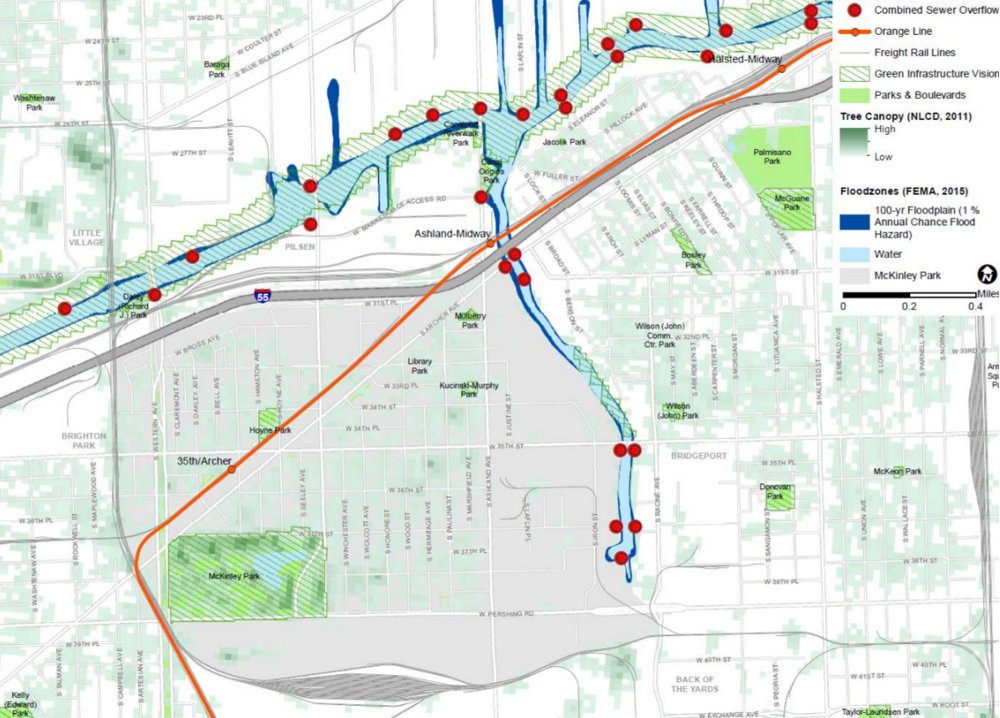
The regional Green Infrastructure Vision (GIV) is a large-scale, multistate vision of interconnected land and water resources and Figure 2.8 illustrates the resources identified at the regional scale for McKinley Park and its extended planning area. Most GIV areas are in neighborhood and community parks including McKinley Park, Hoyne Park, and parts of the Chicago River.
Local Open Space
Residents in McKinley Park have access to approximately 2.6 acres of open space per 1,000 residents. Open Space in McKinley Park is concentrated in the 69-acre McKinley Park, which accounts for the vast majority of open space in the study area. Other parkland spaces include the Western Boulevard, Hoyne Park, Mulberry Park, Kucinski-Murphy Park, and the recently completed Nature Play Garden. Please reference Section 9 of this report for more information on the local open space areas in the community.
Water Source and Supply
Water availability has been a central ingredient to the region’s economic prosperity and may play an even larger role in years to come. The City of Chicago’s Department of Water Management provides Lake Michigan water to McKinley Park.
Storm and Sanitary Sewer System
Maintaining adequate public wastewater sewer infrastructure is vital to public health and clean water. The City of Chicago maintains a combined sewer system that collects both sanitary and stormwater in the same pipe. The city maintains a combined sewer overflow (CSO) permit with the federal National Pollutant Discharge Elimination System (NPDES) permit program. The combined sewers feed into the sub-regional combined sewer system maintained by Metropolitan Water Reclamation District (MWRD), where wastewater is eventually treated at reclamation plants.
The east portion of McKinley Park runs along the South Fork of the Chicago River, which could increase the risk of flooding in the area. Local drainage and sewer systems can become overwhelmed in some locations due to the amount of stormwater runoff leading to localized flooding. Green infrastructure practices can reduce the amount of water flowing into sewers, reduce localized flooding and basement backups, and improve water quality of nearby rivers and streams. During storm events, excess water can flow into the MWRD’s Tunnel and Reservoir Plan (TARP) system for storage. The TARP tunnels are generally located 200 feet below the Chicago River system. Please reference Section 10 of this report for a thorough analysis of flooding in McKinley Park.
Climate Resilience
Climate change has already begun to affect the Chicago region, and will continue to bring more frequent and intense storms, increased periods of extreme heat and cold, and longer droughts. Local impacts may include decreased livability, increased costs to the public sector and private citizens as a result of damage to infrastructure and property, and even loss of life. McKinley Park’s vulnerable populations, such as low-income or the elderly, may be disproportionately burdened by future climate impacts. Such populations may not have access to safe and comfortable living conditions during periods of extreme heat or cold, or might not have the financial resources required to rebound from storm-related property damage.
Figure 2.8 McKinley Park Natural Environment Resources
Source: Chicago Metropolitan Agency for Planning, 2018.










Log In to comment on this item.
Subscribe
Report
My comments